Balance, Theme and Variation, Accent, Cannon
I
Unit: Elements of Dance
Theme: Balance, Theme and Variation, Accent, Cannon
Introduction
Balance
A dancer travels through space, turns on its own axis, elevates his/her body on his/her metatarsals, makes gestures, remain in stillness, uses all body parts, does floor-work and continuously transfers weight from one side of the body to the other. Achieving stillness while in balance is mostly appreciated when coming from a position of imbalance. Going from an off balance position to a position of balance and vice versa is the skill we are developing today.
Theme & Variation
"Theme and variation" is a popular musical form in which a composer states a melody and then repeats it several times with changes to create more interest and variety. In dance, something similar happens. One can create a movement to then repeat it several times with changes in directions, levels, speed, etc, to create more interesting variations.
Accent
An accent in dance is a movement or shape performed in such a way as to give emphasis.
Cannon
Canon is a choreographic
form that reflects the musical or dance forms of the same name, in which
individuals and groups perform the same movement/phrase beginning at
different times. Although it is a choreographic form, we will address it here as a variation of a theme that can be repeated as a cannon.
II
Learning Objectives
- Understand balance, theme & variation, accent and cannon
- Explain what the body has to do to achieve a position of balance to experience the rest of the concepts address today
- Gain an awareness of body weight and its influence on achieving a position of balance to re-create the other concepts
- Experience positions that help the dancer to achieve balance and expand into themes, variations of that theme, accents and cannons
Main Lesson
III
1
WarmUp
Stretching
2
Concepts
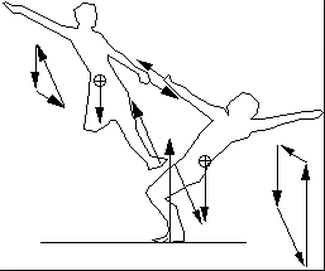
Balance
Balance in dances means there is no force or torque supporting the dancer. In order to keep your balance, force is not needed because your momentum does not change and torque is not needed because your angular momentum does not change.
Question 1
How would you explain balance from a dancer's point of view?
Balance is all about gravity and your center of gravity. In order to stay completely balanced you center of gravity must be directly above the area of contact you have with the floor.
Question 2
What needs to happen for the body to achieve balance?
That’s why when you balance larger objects onto smaller objects, you tend to place that object in the middle so that it is equal on both sides meaning it is completely balanced. If you place one side of the larger object onto the small object, the larger object will fall showing that it is unbalanced.
Thus, balance is keeping weight equal on all sides.
Question 3
How is weight related to the achievement of balance?
Source: https://thephysicsofdance.weebly.com/balancing.html
-----------------
3
What four yoga poses help us achieve balance?
Accent
(min. 0:33)
6
Cannon
Question 5
Write a reflection about canon as danced in the video.
Question 6
What is the difference between theme and variation and canon?
----------------
IV
A Note to Remember
Simultaneous canon - all the dancers start dancing at the same time but at a different point in the dance phrase. This adds depth to the dance. Cumulative canon - as before, the dancers all start at various points in the movement phrase but all finish at the same time.
VI
Activity
Students will add a canon phrase to their existing choreography.
V
A Note to Remember
Balance
is always negotiated while we move. However, achieving balance while
engaging in challenging positions is a skill dancers learn to conquer.
VI
Cannon
Question 5
How does canon enrich the choreography of a dance piece?
VI
Activities
Balance
Students will experience alignment and balance through a yoga session & movement explorations.
They will choose 8 moves that require balance and create a phrase.
Create a movement phrase with 8 moves and turn it into a second phrase by changing levels, speed, directions and size.
Elements of Dance. https://www.turton.uk.com/wp-content/uploads/sites/2/2020/02/Dance-Key-Words.pdf
Dance Glossary. KET Education. https://education.ket.org/resources/dance-glossary/


Comments
Post a Comment